offline website maker download

Capillary Circulation Therapy

Zalmanov Capillary Therapy Benefits: Improve Circulation Naturally

How to improve circulation naturally

Capillaries and Hypertension

Poor circulation is often overlooked, yet it may affect energy, recovery, and overall health.


General Information on Capillaries

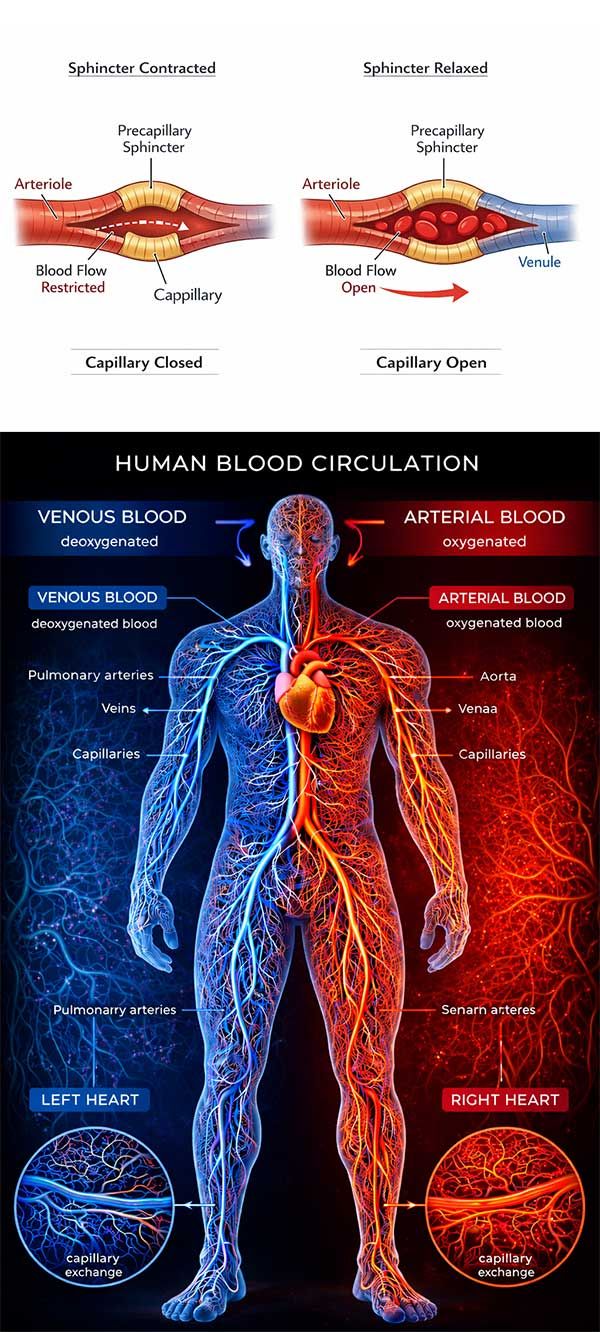
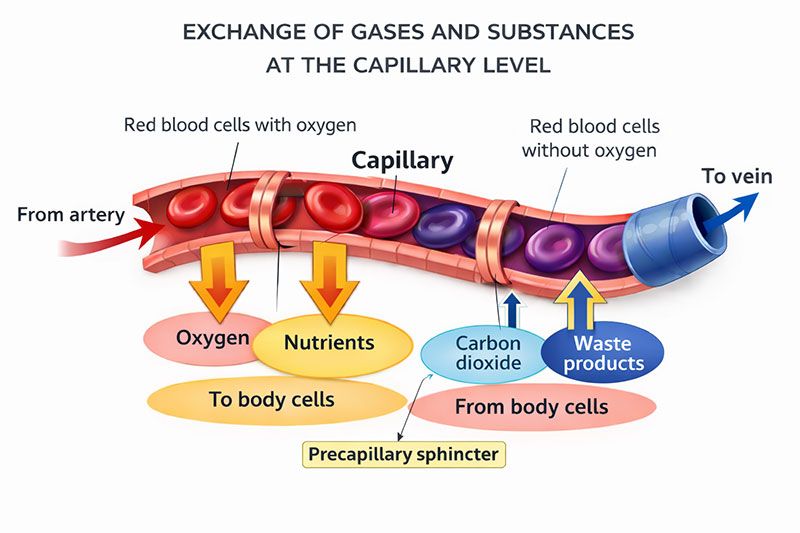
  Capillaries are the body's smallest blood vessels, forming a network that connects arteries and veins, and their main job is to facilitate the crucial exchange of oxygen, nutrients, hormones, and waste products (like carbon dioxide) between the blood and the body's tissues and cells, thanks to their extremely thin, single-cell-layer walls. They are the vital "side streets" that deliver essential supplies to every cell and pick up cellular waste, ensuring tissues get what they need to function and stay healthy.
  Life is the perpetual movement of fluids between and within cells. A cessation of this movement leads to death. A partial slowing of fluid movement in a specific organ causes a partial dysfunction. A generalized slowing of extracellular and intracellular fluids throughout the body results in disease.
A cessation of this movement leads to death. 
   Capillaries, venules and arterioles contain about 80% of blood, the remaining 20% ​​are in large arteries and veins
The total length of the capillaries of an adult is up to 100,000 km.
   The total area of ​​all capillaries is 6300 m²

Hypertension real source

Information from the Last Century Ignored by Modern Medicine

   Classical hemodynamics regards the heart as the central pump that propels blood into the arteries, delivering nutrients to areas where continuous exchange between blood and tissues takes place. According to the classical concept, the capillaries remain inert and passive in this process, as does the entire venous system of circulation. 
   Medical researchers in the last century concluded that capillaries, through the action of precapillary sphincters, could independently propel blood, acting as microscopic hearts. This concept has been fully rejected by modern medical science. The following is a quotation from Zalmanov’s book.
   "Huchard As early as 1908, he established the importance of innumerable peripheral hearts. Rouget emphasized the muscular character of the cells that carry it Name. For Tinel, the Rouget cells are neuromuscular apparatus. Capillary contractions, rhythmic capillary systoles are indisputable for both Tinel and Clarke.
   Zweifach, according to Laborit, emphasizes The role of metaarteriole sphincters (strictly speaking, the term "precapillaries") would be more accurate). Evans gave a detailed description capillary sphincter in the human retina. The capillary as at its exit from the arteriole, and at the junction with the venule it narrows.
   In arterial loop of the capillary is a narrowing, this sphincter (I prefer the term "valve") can reduce blood consumption; in the venous loop The sphincter at the junction with the venule narrows and causes in the capillary stagnation and then expansion of the venous loop.
   Think of each capillary as a microheart with two halves – venous and arterial and with their respective valves and you will understand the great importance of these peripheral hearts for normal and pathological physiology.
   To neglect this phenomenon means neglect the crucial part of blood circulation. (Great names are quite often, alas, they cover up great ignorance)."

     "Diseases of the capillaries - capillaritis (Fahr) or capillaropathy (Zalmanov) - constitute the most important chapter of pathology. We are justified in affirming that they represent the very foundation of every pathological process; without the physiopathology of the capillaries, medicine remains confined to the surface of phenomena and is incapable of understanding either general pathology or special pathology."
                                                                                            A.Zalmanov


FAQ
What is capillary therapy?
Capillary therapy refers to methods aimed at supporting microcirculation and improving blood flow through the smallest blood vessels in the body.
How can I improve circulation naturally?
Circulation may be supported through movement, heat exposure, hydration, and certain hydrotherapy methods.
What are the signs of poor circulation?
Common signs include cold extremities, fatigue, slow recovery, and reduced vitality.

How to Improve Circulation Naturally (Improving circulation naturally is one of the most searched wellness topics today)
 - movement
 - heat exposure
 - hydration
 - hydrotherapy with Zalmanov baths
Why blood flow is important
 - Blood flow is vital for survival because it continuously delivers oxygen, essential nutrients, and hormones to every cell in the body while removing waste products like carbon dioxide and toxins
Signs of poor circulation
 - Poor circulation symptoms often include numbness, tingling, cold hands or feet, muscle cramping (especially in legs when walking), and slow-healing wounds. Other signs include pale or blue skin discoloration, swelling in limbs, varicose veins, and erectile dysfunction